
Exhibition Stand Installation Services That Deliver
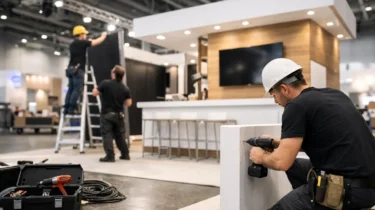
A stand can look excellent on a visual and still fail on the exhibition floor if the practical details have not been managed. Exhibition stand installation services bring the display, venue requirements, build schedule and on-site delivery together, so your team arrives to a branded space that is ready to work from the moment doors open.
For marketing and event teams, that matters because an exhibition is rarely just a graphics project. It is a fixed deadline in a live venue, often with restricted access times, contractor rules, service orders and health-and-safety documentation. The right installation partner removes those moving parts from your internal workload while protecting the quality of the finished result.
What exhibition stand installation services should cover
Installation is the final visible stage of a much wider delivery process. A reliable service starts by understanding the event, your stand footprint, visitor flow, display objectives and venue rules. It then turns those requirements into a practical build plan that accounts for equipment, graphics, flooring, electrics, internet access and any supplied furniture or accessories.
This matters particularly when several suppliers are involved. A print supplier may produce graphics, a stand-hire company may provide hardware and the venue may manage technical services, but somebody still needs to make sure each element arrives at the right time and works together. One accountable delivery partner reduces the risk of gaps between suppliers becoming your problem on build day.
A well-managed installation service will usually include the coordination of delivery slots, vehicle access, loading arrangements, stand construction, graphic fitting, on-site checks and dismantling after the event. The exact scope depends on the venue and the size of the stand, but the principle remains the same: the finished environment should be safe, properly presented and ready for your sales team.
Plan the build before the event manual arrives
The strongest exhibition builds are planned early, not rescued late. Venue manuals can contain detailed rules on build-up hours, maximum construction heights, hanging signs, electrical connections, floor loading, fire ratings and contractor access. Missing one requirement can lead to extra costs, delays or an unwelcome redesign close to the show.
Start with the basics: the stand number, dimensions, open sides, event dates and build-up window. From there, consider how visitors will enter the space, where conversations will take place and whether demonstrations, product displays or lead capture need power and connectivity. A stand that looks impressive in a rendering may be less effective if it leaves no practical room for staff, storage or visitor movement.
Services need to be ordered, not assumed
Electrics, flooring and internet are commonly venue-managed services. They need ordering to the correct position on the stand plan, often well before the exhibition opens. It is also worth checking what is included. A standard electrical supply may not be suitable for multiple screens, lighting, charging points or demonstration equipment, while venue Wi-Fi may not meet the needs of a live product demonstration.
Trade Show Solutions can coordinate these practical requirements alongside the display build, helping clients avoid the familiar last-minute scramble for an extension lead, a missing socket or a connection that has been ordered in the wrong place.
Choose a system that suits the event programme
Not every stand needs the same level of construction. The best choice depends on the available space, how often you exhibit, the level of visual impact required and whether the display needs to travel between venues.
T3 modular systems are a practical option for businesses that need a more substantial branded environment without commissioning a one-off build for every event. The framework is tool-free, configurable and reusable, allowing the same core components to be adapted for different footprints. New graphics can refresh a campaign or product launch without replacing the entire structure, which can improve value across a busy event calendar.
Tension-fabric displays are lightweight, portable and quick to assemble. They work well for shell-scheme spaces, conference backdrops, roadshows and activations where speed of transport and a clean branded finish are priorities. They may not provide the storage, height or architectural presence of a larger modular build, but they can deliver a strong result where the brief is straightforward and the event team needs flexibility.
Printed signage also plays a part in making the space functional. Foamex, acrylic, DiBond and Correx can be specified for product information, directional signs, pricing, window displays or temporary promotional messages. Material choice should reflect how and where the sign will be used. A low-cost temporary board may be appropriate for a short campaign, while a durable rigid panel is a better fit for repeated use or a premium retail environment.
Compliance is part of the installation, not an extra
Venue-based events operate under strict safety controls. Depending on the event and stand design, exhibitors may need risk assessments, method statements, proof of public liability insurance, electrical documentation and details of contractors attending site. If the stand involves anything beyond a simple pop-up display, these requirements should be addressed early.
Risk assessments identify the hazards connected with delivery, construction, working at height, manual handling and the finished stand. Method statements explain how the work will be carried out safely. They are not paperwork for paperwork’s sake. They provide a clear working plan for the build team and demonstrate to organisers that the project has been properly controlled.
Fire safety is another consideration. Graphic materials, flooring and fabric displays may need to meet specific standards, especially in larger venues. A professional installation service should be able to identify relevant requirements, provide suitable documentation and ensure the stand is constructed in line with the approved plan.
What happens on installation day
Build day is where preparation pays off. The installation team should arrive with the required stand components, graphics, fixings, tools and site information, then work to the agreed schedule and venue access rules. For a modular stand, this may involve constructing the frame, fitting fabric or rigid graphics, installing counters and display accessories, then completing final alignment and cleaning.
The final check is not simply visual. It should confirm that branded elements are positioned correctly, graphics are free from damage, electrics are accessible, flooring is secure and the stand is safe for staff and visitors. Storage areas, literature racks, screens and product plinths should also be checked from the user’s point of view, not only the installer’s.
Dismantling deserves the same attention. Reusable hardware needs to be packed carefully, labelled and returned to storage in good order. Retaining the framework while replacing campaign graphics for future shows can reduce waste and make later events quicker to organise.
Questions to ask before appointing an installer
Before committing to an installation provider, establish whether they can manage the full scope rather than only the physical build. Four questions will quickly reveal how prepared they are:
- Can they produce or coordinate the stand, graphics, signage and accessories as one project?
- Will they review venue requirements and support risk assessments and method statements?
- Can they coordinate venue services such as electrics, flooring and internet?
- Do they provide delivery, on-site installation, dismantling and storage options where required?
It is also sensible to ask how changes are handled. Exhibitions often involve late amendments to artwork, product messaging, stand positions or service requirements. A capable supplier will be clear about deadlines, costs and the practical impact of those changes, rather than making promises that cannot be delivered on site.
Make each event easier than the last
The most cost-effective exhibition approach is rarely to start from scratch every time. Reusable modular hardware, portable fabric displays and carefully stored signage give businesses a reliable base for future events. They also create consistency: your brand appears considered and recognisable whether it is shown in a compact shell scheme, a conference foyer or a larger open-space stand.
Keep an accurate record of the components used, graphic sizes, venue plans and service orders for each show. That information makes future planning faster and helps identify what genuinely worked. Perhaps a meeting counter proved more useful than a brochure rack, or perhaps the stand needed better storage and clearer product messaging. Those practical lessons are where event performance improves.
A professionally installed stand gives your team more than a polished backdrop. It gives them the time and confidence to focus on conversations, demonstrations and leads while the physical environment has already been properly handled.