
Choosing a Tension Fabric Exhibition Backdrop
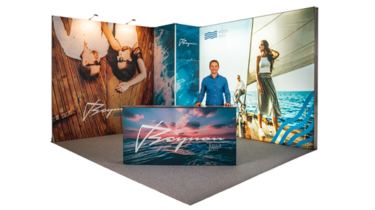
A tension fabric exhibition backdrop can turn a standard shell scheme space, conference foyer or compact promotional area into a credible branded environment. But the best result is not simply a matter of selecting an attractive graphic. The frame size, fabric finish, sightlines, transport plan and installation method all need to suit the event and the way your team will use the space.
For exhibitors working across several events, tension fabric is often a practical alternative to one-off printed panels or a fully bespoke build. It is lightweight, reusable and quick to assemble, while the stretch graphic creates a clean, continuous visual surface with no obvious joins. The key is specifying it as part of a stand plan rather than treating it as a last-minute print purchase.
What a tension fabric exhibition backdrop does well
A tension fabric backdrop uses a lightweight aluminium frame and a printed polyester graphic with a stitched silicone edge. Once the graphic is pressed into the frame channel, the fabric sits under tension to produce a smooth, professional finish. Depending on the system, the frame can be free-standing, wall-mounted, single-sided or double-sided, with options for integrated lighting, feet, stabilisers and return panels.
Its biggest strength is visual consistency. Large-format fabric printing carries colour blocks, photography and campaign artwork across one uninterrupted display face. This is especially useful when a stand must communicate a clear message from a distance, whether that is a product launch, a major brand visual or a simple proposition for visitors moving through a busy hall.
It also suits organisations that need to reuse their investment. The aluminium hardware can serve multiple campaigns, with replacement graphics produced for different product ranges, events or seasonal messaging. That can be more commercially sensible than buying a new display for every show, particularly where the frame dimensions remain useful across a regular event programme.
Portability matters too. Many systems break down into manageable sections and travel in protective bags or wheeled cases. For a small exhibition team, that reduces the difficulty of getting branded display materials from the office to the venue. It does not remove the need for planning, however. Larger frames, lighting and accompanying counters still require realistic consideration of vehicle space, delivery slots and who is responsible for assembly.
Choosing the right tension fabric exhibition backdrop size
The right size depends on the stand footprint, the venue and the distance from which visitors first see it. A backdrop that fills a three-metre shell scheme wall may be ideal for a compact lead-generation stand, but it will feel underpowered as the only branded feature on a six-metre open-sided space. Conversely, an oversized wall in a narrow conference area can make access awkward and reduce space for conversations.
Start with the floor plan. Establish where the open sides are, where visitors will approach from and where staff need room to meet people. Consider the location of shell scheme poles, fire exits, venue columns and service points before fixing a graphic size. A backdrop should support the visitor journey, not consume the entire usable area.
Height needs the same care. Taller displays increase visibility across an exhibition hall, but venue rules may limit build height, particularly within shell scheme packages. They can also affect whether you need approval, complex rigging arrangements or additional stabilisation. In lower-ceiling conference spaces, a more modest backdrop with carefully positioned lighting may achieve a better result than pushing for maximum height.
For many exhibitors, a fabric wall works best as the visual anchor of a wider stand. It can sit behind a reception counter, frame a demonstration area or create a meeting backdrop, with matching signage, literature holders and product display around it. Where the objective is to create a fuller branded environment, modular exhibition components can add meeting rooms, storage or architectural height while the fabric graphic delivers the main campaign message.
Graphics must work from the aisle
A fabric graphic is printed at scale, so artwork that looks good on a laptop screen can fail quickly on the show floor. Visitors may only give you a few seconds as they pass. Your main message should be readable at a glance, with a clear hierarchy between the brand, headline, supporting information and call to action.
Avoid trying to put an entire brochure onto the backdrop. Long paragraphs, small product specifications and multiple competing messages tend to disappear at exhibition viewing distances. A strong campaign image, a concise headline and a simple reason to stop are usually more effective. Detailed information can sit on a counter, digital screen, printed handout or follow-up material.
Image quality is equally important. Large-format print exposes poor-resolution photography and unsuitable artwork. Supply properly prepared files at the agreed scale and allow for bleed, frame edges and any areas concealed by feet or accessories. If the graphic includes faces, products or fine lines close to the edges, confirm the visible area before artwork is approved.
Colour should be managed with the same discipline. Brand colours can behave differently across printed materials and under venue lighting. A print proof or colour reference process is worthwhile for critical identity colours, especially if the backdrop needs to match existing signage, counters or modular stand graphics. The aim is a coherent space, not a collection of individually acceptable items.
Plan assembly, lighting and venue practicalities
One reason tension fabric displays are popular is their straightforward assembly. Many frames are tool-free, and the graphic is fitted by working around the edge rather than pulling fabric across the whole frame. That makes them suitable for teams handling a simple portable display themselves, provided they have been shown the correct process and have enough time before doors open.
Still, simple does not mean automatic. Assign a person to check every frame section, foot, graphic and light before dispatch. Pack components in labelled cases, keep a copy of the assembly guide with the kit and allow time to inspect the finished display for creases, exposed edges or a graphic fitted the wrong way round. A clean fabric glove can help prevent marks during fitting, while a lint roller is useful for a final check under exhibition lighting.
Lighting can substantially improve a backdrop, particularly in halls with uneven ambient light. LED floodlights or integrated illumination can bring out imagery and make a message visible from further down the aisle. The trade-off is that lighting requires booked electrics, cable management and a suitable position within the venue’s rules. Do not assume a plug socket will be available or included with the stand package.
For larger stands, the backdrop should be planned alongside flooring, internet, screens, product displays and power requirements. Cable routes must be safe and tidy. Emergency exits, fire points and neighbouring exhibitors’ boundaries must remain clear. If the display is part of a more substantial build, risk assessments and method statements may be required, along with coordination of delivery times, loading bay access and on-site build arrangements.
Reuse the hardware without repeating the same campaign
The most useful tension fabric systems are designed around repeat use. Keep the frame, feet and cases protected between events, then order new fabric skins when the campaign changes. This allows a business to maintain a consistent display format while adapting its message for a sector-specific exhibition, roadshow or product launch.
That flexibility has limits. Reusing a frame makes sense when the stand size and format remain broadly stable. If your exhibition programme has moved from small shell schemes to larger island spaces, or if you now need private meeting areas and overhead visibility, a portable backdrop alone may no longer be enough. A modular system can provide the structure and adaptability, while tension fabric graphics give it a high-impact branded finish.
Fabric should also be cared for properly. Fold it neatly, keep it dry and store it away from sharp hardware or adhesive materials. Most creases relax once the graphic is tensioned on the frame, but poor storage can create marks that take attention away from the stand. Check every graphic before it goes back into circulation, particularly after events where it has been handled by multiple people or packed down under time pressure.
When professional delivery adds value
A portable fabric wall is a sensible self-build choice for some teams. For others, the internal time saved by having one supplier manage graphics, hardware, transport and installation is more valuable than doing it in-house. This is particularly true when the event includes venue services, compliance paperwork, tight build windows or several display elements that need to align precisely.
Trade Show Solutions can plan a tension fabric backdrop as one part of a working event space, coordinating the display with counters, signage, modular structures, flooring, electrics and on-site installation. That gives marketing and event teams one accountable route from approved artwork to a finished stand.
The most effective backdrop is the one that is easy to transport, quick to build, clearly on-brand and appropriate for the actual venue. Get those practical decisions right early, and your team can arrive focused on visitors and conversations rather than frames, fittings and last-minute fixes.