
Tension Fabric Versus PVC Banners: Which Works?
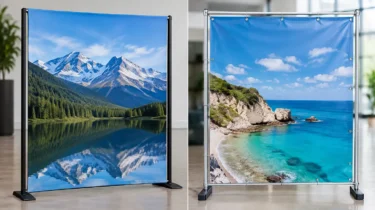
A display can look excellent in an artwork approval and still create unnecessary work on the event floor. When comparing tension fabric versus PVC banners, the useful question is not which material is universally better. It is which one suits the event setting, the frequency of use, the required finish and the way your team needs to transport, install and store it.
For a one-off banner in a large venue, PVC can be a direct and cost-effective answer. For a branded exhibition space that will travel through a busy event programme, a tension-fabric display often provides the more polished and reusable option. The difference affects more than print appearance. It changes how the display is packed, built, maintained and presented to visitors.
Tension fabric versus PVC banners: the practical difference
Tension-fabric graphics are printed textile covers that stretch over, or fit around, a lightweight aluminium frame. The fabric is held taut by the frame, commonly using a silicone edge or a zipped finish. Once assembled, the result is a smooth, continuous branded surface with minimal visible fixings.
PVC banners are printed vinyl sheets, generally finished with hems, eyelets, pole pockets or reinforced edges. They are secured to walls, railings, fences, truss, shell scheme structures or purpose-made banner frames using cable ties, bungees, hooks or other fixings. They are familiar, hard-wearing and well suited to applications where a flexible printed panel is needed rather than a self-supporting display.
Both can carry high-impact graphics, but they create a different impression. A properly tensioned fabric system has a softer, more premium finish and is particularly effective for stand backwalls, modular exhibition stands, photo opportunities and conference stages. PVC has a more functional, banner-led appearance. That is not a drawback when the purpose is clear directional messaging, perimeter branding or a large temporary graphic, but it may not deliver the same refined finish for a customer-facing exhibition stand.
Where tension fabric earns its place
For indoor exhibitions and conferences, tension fabric is usually chosen for presentation quality and repeat use. The fabric sits closely against the frame, avoiding the ripples, glare and loose edges that can occur with a hung banner. It also photographs well under exhibition lighting, which matters when the stand will appear in event photography and social content.
Reusable hardware, replaceable graphics
The strongest commercial case for tension fabric is not simply the print itself. It is the reusable framework. A portable fabric backwall, lightbox or modular fabric stand can be used across multiple events, while new graphic covers can be ordered for product launches, campaigns or changing messages.
This approach is especially useful for businesses attending several exhibitions each year. Rather than starting with a new display every time, the team can retain the core hardware and refresh the visual element. It also helps maintain a consistent stand footprint while allowing each event to have its own campaign focus.
Better suited to portable exhibition spaces
Fabric systems are designed to break down into manageable sections and transport in cases or wheeled bags. Assembly is generally tool-free, although larger modular configurations may benefit from an experienced installation team to ensure every graphic is correctly tensioned and aligned.
That portability can reduce the practical burden on marketing teams. Instead of arranging a separate hanging solution for each banner, they have a self-contained display system that can form a branded backdrop almost anywhere on the stand. Where a venue requires a formal build schedule, Trade Show Solutions can also coordinate installation alongside flooring, electrics, internet and other stand services.
Points to consider before specifying fabric
Tension fabric relies on the correct frame and a clean, accurate graphic cover. It is not the best choice for every location. Outdoor use needs careful consideration of wind loading, weather exposure and the suitability of the frame. It should not be treated as an outdoor banner simply because the graphic itself is fabric.
Fabric graphics also need sensible handling. They should be folded or packed as instructed, kept dry and checked before dispatch. Most light creases relax once the cover is tensioned on the frame, but poor storage can affect the finish. For an important launch or client event, it is sensible to inspect graphics before they leave for the venue.
When PVC banners are the better fit
PVC remains a practical choice for many event and promotional applications. It is durable, adaptable and easy to specify at large sizes. If the display needs to attach to an existing surface or span a temporary structure, a PVC banner may be the simplest solution.
It is particularly useful for outdoor events, site hoardings, sports and sponsorship branding, loading-area signage, festival perimeters and short-term promotional campaigns. With the right finishing, PVC can be secured firmly to a suitable structure and withstand the tougher conditions that would make a portable fabric frame unsuitable.
Flexible fixing options
A PVC banner can be made to suit the way it will be installed. Eyelets allow fixing to fencing or walls, pole pockets work for railings and crossbars, and reinforced hems add strength for larger formats. The specification should always follow the fixing method, not the other way around.
This is where planning matters. A banner that is too tightly fixed can tear in windy conditions, while one with insufficient fixing points can flap, sag or become a safety concern. For external displays, the location, wind exposure, banner size and supporting structure all need to be assessed before production.
A sensible option for one-off messaging
If the requirement is a single, temporary message rather than a reusable branded environment, PVC often makes commercial sense. A sponsor banner, event entrance sign or directional graphic may only be needed for a weekend. Buying a frame and fabric cover for that use would add cost and storage requirements without necessarily improving the outcome.
PVC can also be the right choice where visual perfection at close range is less important than clear messaging at scale. A large banner above a registration desk or across a venue entrance needs strong artwork, legible type and secure installation. It does not always need a full exhibition system behind it.
Cost is more than the initial print price
Comparing the price of a fabric graphic with a PVC banner alone can be misleading. Tension fabric usually involves a higher initial outlay because it includes a frame or modular hardware. Over repeated events, however, that hardware can spread its cost while replacement graphics provide a more efficient way to update the message.
PVC generally has a lower entry cost for a single printed panel, especially when it is attached to infrastructure already available at the venue. But each new campaign may require a new banner, and the team must still plan how it will be fixed, transported and stored.
The right calculation should include the number of planned uses, delivery and collection requirements, venue restrictions, available storage and internal setup time. A lower-cost item that takes two people an hour to install, or requires last-minute venue fixes, can be more expensive in practice than a reusable system that goes together quickly and predictably.
Match the material to the event environment
Indoor exhibition stands usually favour tension fabric where the objective is a clean, premium backdrop or a complete branded setting. It integrates well with counters, shelving, lightboxes and modular systems, and it gives sales teams a professional space in which to hold conversations.
PVC is often the stronger choice for temporary outdoor branding or where the display must be fixed to an existing structure. It is also valuable within indoor venues for functional signage, short-term promotions and large-format messages where a framed system is unnecessary.
There are situations where the best answer is both. A conference may use tension-fabric backwalls and counters in the main presentation area, then PVC banners for vehicle access routes, registration directions or external sponsor branding. This keeps the customer-facing environment polished while using the appropriate material for each operational need.
Plan graphics and logistics together
The most effective display decisions happen before artwork is finalised. Consider viewing distance, stand position, lighting, access routes, rigging restrictions and whether the display will be installed by your own team or by venue-approved contractors. These practical details influence size, finish, fixings and the amount of copy that can be read comfortably.
For a tension-fabric system, confirm the exact frame dimensions and whether graphics need to cover one side or both. For PVC, confirm fixing points, structural support and whether the banner will be exposed to wind. If the event has formal health-and-safety requirements, the installation method should sit within the risk assessment and method statement rather than being decided on arrival.
A good display material should make the event easier to deliver, not create another problem for the build team. Choose tension fabric when you need a reusable, self-supporting branded presence with a refined finish. Choose PVC when you need durable, flexible printed signage that can be fixed securely to the environment. The strongest event spaces use each where it does its job best.