
DiBond versus Foamex Signage: Which Works?
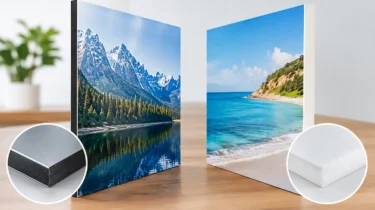
A reception sign that needs to look immaculate for three years has very different requirements from a set of directional boards used for a two-day exhibition. That is the practical decision behind DiBond versus Foamex signage. Both materials produce sharp, professional printed graphics, but their weight, finish, durability and cost make each one better suited to particular jobs.
For exhibition and event teams, the right choice is rarely about selecting the most expensive board. It is about choosing a material that will arrive safely, install cleanly, meet the demands of the venue and still look right for the duration of the campaign.
DiBond versus Foamex signage: the key difference
DiBond is an aluminium composite material. It has two thin aluminium faces bonded to a solid polyethylene core, creating a flat, rigid panel with a premium feel. It is widely used for external signage, permanent branded panels, site boards, retail graphics and presentation signage where a clean finish matters.
Foamex is a rigid PVC foam board. Despite the name, it is not soft or flexible like packaging foam. It is a lightweight, smooth board that prints well and is commonly used for indoor displays, temporary event signage, promotional boards and exhibition graphics.
Both can be printed directly with high-resolution graphics, cut to shape and supplied with drilled fixing holes where needed. The important distinction is how they perform once they leave the print room. DiBond is denser, stiffer and more resistant to wear. Foamex is lighter, more economical and easier to handle in quantity.
When DiBond is the stronger choice
DiBond is often the right material where signage will remain in place for a long period, face frequent handling or be used outside. Its aluminium surface gives it a crisp, professional appearance that suits company signs, wayfinding, branded entrance panels and high-visibility graphics.
For an exhibition stand, DiBond works particularly well for smaller premium details: a reception-desk fascia, raised-looking logo panel, product information board or a fixed sign mounted to a modular structure. It stays exceptionally flat and gives graphics a more substantial feel than a lightweight board.
The material also performs well when panels need to be cleaned regularly. This can be useful for retail installations, visitor centres and branded environments that remain live beyond a single event. While no printed panel is indestructible, DiBond is less likely to show minor knocks and handling marks than Foamex.
There are trade-offs. DiBond costs more than Foamex, and its additional weight becomes significant when a project includes numerous large panels. A 3m-wide set of DiBond graphics may need more considered transport, appropriate fixings and a planned installation method. For a temporary conference where boards are installed in the morning and removed that evening, that extra durability may not deliver a worthwhile return.
Best uses for DiBond
Choose DiBond when the priority is longevity, rigidity or a premium finish. Typical applications include external signs, permanent internal branding, retail display panels, landlord signage, reception areas, directional signs exposed to heavy footfall and exhibition features intended for repeated use.
It is also a sensible option if panels must withstand repeated loading, unloading and storage between events. Careful packing still matters, particularly at corners, but DiBond has the resilience to support a longer-term signage programme.
Where Foamex makes more commercial sense
Foamex is a practical workhorse for temporary displays. It is lighter than DiBond, simple to position during a build and cost-effective for campaigns that need multiple panels, changing messages or short-term use.
At trade shows and conferences, Foamex is commonly used for product boards, promotional signs, price displays, wall-mounted graphics, directional signs and temporary branded zones. The smooth face supports strong colour reproduction, making it suitable for logos, photography and clear marketing messages.
Its lower weight can reduce handling time on site. That matters when an event team is working to a fixed access slot, carrying graphics through a venue or installing signage around counters, shell scheme walls and modular displays. Lightweight boards are also useful where the supporting surface has limits on what can be fixed to it.
Foamex is available in different thicknesses, allowing the board to be matched to the job. Thinner material is often appropriate for short-term internal graphics, while thicker board gives greater stiffness for freestanding or larger-format panels. The right thickness depends on panel size, fixing method and whether the board will be reused.
Foamex is not automatically the cheaper answer in every situation. A thin panel may save money at the point of purchase, but it can be more vulnerable to bent corners, dents or bowing if it is oversized, poorly supported or repeatedly transported. For a single-use internal campaign, this is usually an acceptable compromise. For signage that will travel to several venues, it may be worth specifying a thicker board or moving to DiBond for the most exposed elements.
Best uses for Foamex
Foamex is well suited to indoor exhibition graphics, conference signage, point-of-sale displays, temporary wayfinding, promotional panels and short-term retail activations. It is particularly effective when a campaign needs several printed boards but does not need the long service life of aluminium composite.
For marketing teams refreshing messaging regularly, Foamex can provide the visual impact needed without committing budget to a material designed for years of use.
Consider the environment, not just the design
The board should be selected after looking at where it will be used. A sign located inside an exhibition hall faces different risks from one mounted outside a venue entrance. Weather, wind, sunlight, public contact, cleaning requirements and installation method all affect the specification.
For external signage, DiBond is generally the more dependable option. It offers better resistance to the movement and wear that can affect lighter PVC foam boards outdoors. If a project includes outdoor wayfinding, site branding or signage at an entrance, the panel fixings and supporting structure also need to be appropriate for the location.
For internal events, Foamex often performs perfectly well. The priorities are usually clear print, safe edges, suitable fixing and straightforward removal at the end of the show. A lightweight board can be a benefit in venues with strict build schedules and restrictions on drilling or permanent alteration.
Venue requirements should also be checked early. Exhibition organisers may specify approved fixing methods, limits on suspended weight, fire-performance documentation or restrictions on where boards can be positioned. Signage is part of the wider stand build, not an isolated print order. Planning it alongside flooring, electrics, counters and display hardware avoids last-minute changes on site.
Print finish and visual impact
Both materials can deliver excellent branded graphics. The artwork, print process, lighting and panel preparation often have more influence on the final look than the choice between DiBond and Foamex alone.
DiBond tends to feel more refined because it remains very flat and has a firmer edge. This is valuable for reception signs, polished retail environments and close-up product displays. Foamex also prints cleanly and can look highly professional, particularly when mounted neatly within an exhibition stand or used as part of a larger branded display.
If the panel will be viewed at close range, consider the practical finishing details. Cut edges, drilled holes, corner treatment and fixing positions should support the intended look. A well-designed Foamex panel will look better than a poorly planned DiBond board, regardless of material cost.
Transport, installation and reuse
Signage choices affect the event-day workload. Foamex is easier to carry and quicker for smaller teams to position, but it needs protection against pressure and corner damage in transit. DiBond is heavier, yet its rigidity can make installation more controlled where a perfectly flat panel is required.
For reusable exhibition assets, establish how the boards will be packed, stored and reinstalled before ordering. Large panels need suitable cases, padded protection or purpose-made crates. Reusing hardware, such as a modular frame or tension-fabric system, while replacing only campaign-specific graphics can also be more efficient than storing large rigid boards between events.
Trade Show Solutions can coordinate signage with the wider exhibition build, including graphic placement, installation planning and the practical requirements of the venue. This is particularly useful when multiple materials are needed across one stand, rather than trying to make every sign perform the same job.
Make the material earn its place
Choose DiBond when your signage needs to stay flat, look premium and withstand long-term use or tougher conditions. Choose Foamex when you need sharp, lightweight and cost-conscious panels for indoor events or temporary campaigns. In many exhibition projects, the strongest answer is a combination of both: DiBond for permanent or high-contact features, and Foamex for changeable campaign messaging.
The useful question is not which board is universally better. It is which board will still look right when the doors open, fit the installation plan and justify its cost for the life you need from it.