
Tension Fabric Versus Pop Up: Which Is Best?
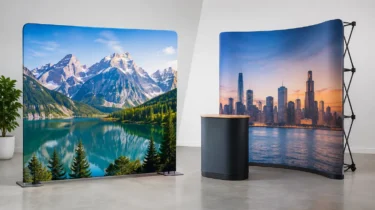
A display that looks polished in a meeting room can become a liability at a busy exhibition if it is slow to assemble, difficult to transport or unable to carry the brand message clearly. The tension fabric versus pop up decision is therefore about more than appearance. It affects how your team travels, how much storage you need, how quickly you can be event-ready and how easily the display can support future campaigns.
Both formats are established options for shell-scheme spaces, conferences, roadshows and smaller activations. Both can create a professional branded backdrop without the cost and commitment of a fully bespoke stand. Their construction, graphic finish and best use cases are different, however. Choosing well starts with understanding what each system is designed to do.
Tension fabric versus pop up: the key difference
A tension-fabric display uses a lightweight aluminium frame and a printed stretch-fabric graphic. Depending on the system, the fabric either slips over the frame like a fitted cover or is edged with silicone beading that pushes into a channel in the frame. Once fitted, the graphic is pulled taut to create a smooth, continuous surface.
A traditional pop-up display uses a folding scissor frame that expands into shape. Printed graphic panels are then attached to the frame, typically using magnetic strips or hook-and-loop fixings. It is a familiar portable format and is often supplied with a wheeled case that can double as a branded counter.
There is one point worth clarifying when comparing quotations: some suppliers use the term fabric pop-up for a collapsible frame fitted with a fabric graphic. This hybrid option has the fast-opening convenience of a pop-up mechanism but a softer textile finish. Ask exactly what frame and graphic attachment method are included. A display described simply as a pop-up may not provide the same finish, packing size or graphic-change options as another.
Appearance and graphic quality
For a large, uninterrupted branded wall, tension fabric is usually the stronger visual choice. The stretch material produces a clean face without the joins between rigid panels. It is particularly effective for bold colour blocks, lifestyle imagery, large logos and backdrops that will appear in photography or video.
Fabric also avoids the glare that can occur on laminated graphic panels under exhibition hall lighting. That matters on stands with strong spotlights, open sides or a presentation area where people will be taking photographs. The material finish can make a compact space feel more considered, even where the hardware remains highly portable.
Traditional pop-up systems can still look smart, particularly for straightforward brand messaging and repeatable layouts. The panel joins are visible at close range, though, and panels can show wear at their edges after frequent handling. If the design relies on a single image running across the full width, the joints need careful artwork planning so that faces, product details and small type do not fall across them.
Print quality is only part of the outcome. A well-produced graphic needs the right scale, safe margins and resolution for its final size. It should also be designed around the display’s frame, feet, joins and any lighting positions. This is where practical stand planning prevents a graphic that looks correct on screen from becoming compromised on site.
Setup time, transport and storage
Pop-up displays earned their place because they are quick to deploy. The frame opens in seconds, and a practised user can attach pre-mounted panels efficiently. For an occasional exhibitor travelling by car to a one-day conference, that simplicity is attractive. The wheeled case keeps the main components together and offers good protection in transit.
The trade-off is bulk. A pop-up may pack into one manageable case, but it is not always light, and the rigid panels need care. Repeated use can create scuffs, curled edges or damaged magnetic strips. Replacement panels are possible, but they need to match the existing system accurately.
Tension-fabric systems take a little longer to assemble because the frame sections must be connected before the graphic is fitted. Most use numbered or push-fit aluminium parts, so assembly is tool-free and methodical rather than difficult. Once the process is familiar, a standard straight fabric wall is realistic for one or two people to build without specialist equipment.
For transport, tension-fabric frames break down into compact carry bags, while the graphic folds into a separate bag. This is helpful when storage space is limited, when displays are sent by courier, or when a team needs to take branding between multiple locations. Fabric graphics can often be washed or steamed carefully if required, whereas rigid panels are less forgiving once marked or creased.
When a pop-up display is the practical choice
A traditional pop-up works well where speed and self-service are the main priorities. It suits an organisation that attends a few local events each year, has a consistent message and needs a familiar display format that can be stored in the office and loaded into a car.
It can also be a sensible choice for short-lived campaigns. If the display is needed for a handful of dates and the graphics are unlikely to change, the straightforward construction can offer good value. Add a counter conversion kit and a case can become a useful point for literature, samples or lead capture.
That said, the available stand space should guide the decision. A pop-up backdrop alone does not create a complete exhibition environment. You may still need a branded counter, literature holder, freestanding signage, flooring, lighting and a plan for power. In a shell scheme, it should be positioned so that it supports the visitor journey rather than blocks access to the stand.
When tension fabric is the better investment
Tension fabric is often the more appropriate choice for businesses that exhibit regularly and want a premium, reusable branded presence. It works especially well for product launches, conference stages, recruitment events and roadshows where the display needs to look consistent across several venues.
The clean graphic face makes it easier to create a strong visual focal point, while replacement fabric skins allow campaigns to change without replacing the frame. A company can keep the same hardware for core branding, then order alternate graphics for a new product range, sector-specific event or seasonal message. This reduces waste and supports more controlled long-term event spend.
Fabric systems also offer more scope beyond a simple backdrop. Curved walls, enclosed meeting areas, illuminated frames, branded towers and fabric counters can be combined into a coordinated space. For a larger plot, they can sit alongside a modular system to create meeting zones, storage or product demonstration areas without making the stand feel visually fragmented.
The consideration is installation responsibility. A small fabric wall is suitable for competent in-house assembly, but larger configurations, overhead elements, integrated lighting or multi-part stand layouts benefit from experienced installation. Venue access times are limited, and any delay can put pressure on the rest of the build.
Consider the full event environment
The display itself is only one part of an exhibition delivery. A branded backdrop has to work with venue rules, shell-scheme dimensions, access routes, fire regulations and the services needed to make the stand operational. For example, lighting may improve graphic impact but requires power ordered from the venue. A screen or live demonstration may need internet provision, cable management and a suitable risk assessment.
For a larger tension-fabric or modular installation, organisers may also require method statements, public liability documentation and details of the build team. Flooring, furniture and storage all affect the footprint available to visitors. These requirements are not reasons to avoid a more ambitious stand, but they should be planned early rather than added in the final week.
Trade Show Solutions can coordinate display hardware, printed graphics, signage, venue services and on-site installation as one managed project. That is particularly useful where an internal marketing team needs a polished outcome without becoming the point of contact for separate print, logistics and build suppliers.
A practical way to choose
Start with the events you will actually attend over the next 12 to 24 months. If you need a compact backdrop for infrequent, locally managed events, a conventional pop-up can be the efficient answer. If visual finish, graphic flexibility and repeat use matter more, a tension-fabric system is likely to offer better value over time.
Then assess who will build it, how it will travel and where it will be stored between events. Consider whether the stand needs to grow with your programme, whether graphics will change by audience or campaign, and whether the venue requires professional installation and compliance paperwork. The right display is the one that works reliably not just on opening morning, but through every journey, build and future event that follows.