
Are Shell Scheme Graphics Reusable? What to Check
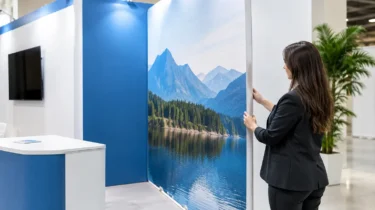
A shell-scheme stand can look sharp on opening morning, then become an awkward pile of panels in the office after the event. So, are shell scheme graphics reusable? Usually, yes – but only when the graphics, fixing method and future stand layouts have been planned with reuse in mind.
For businesses exhibiting more than once a year, reusable graphics can reduce print spend, shorten preparation time and keep brand presentation consistent. The limitation is that a shell scheme is a venue-provided structure, and its dimensions, wall configuration and fixing rules can change from one event to the next. Treating every panel as universally reusable can create expensive surprises at the next show.
Are shell scheme graphics reusable across events?
Shell scheme graphics are most reusable when they are produced as individual, removable panels to suit standard exhibition wall bays. Rather than applying graphics directly to the shell-scheme wall, the printed panels are fixed over the existing surface using an approved method, commonly hook-and-loop tape. After the event, they can be removed, packed flat and used again where the bay dimensions match.
This approach works well for logos, core brand messaging, product ranges and imagery with a longer shelf life. A company attending several trade shows with the same proposition can retain the majority of its graphics and only replace targeted content, such as campaign messaging, dates, product launches or lead-generation calls to action.
However, reuse is not automatic. A graphic made for a 3 m x 2 m open-front shell scheme may not fit a corner stand, a space with a storage cupboard, or a venue using a different shell-scheme contractor. Even a small difference in panel width can leave visible gaps, force an overlap or interfere with the aluminium frame.
The practical answer is that reusable shell-scheme graphics should be designed around repeatable panel sizes, with flexibility built into the layout from the outset.
What affects whether graphics can be used again?
The condition of the print matters, but so does the structure it is intended to cover. Before committing to a reusable set, assess the likely event programme rather than the first exhibition alone.
Stand size and wall layout
Most shell schemes use modular wall panels, but there is no single measurement that applies to every UK venue and organiser. A standard bay may be close to 1 m wide, yet usable print areas vary according to the frame, channels, lighting tracks and any doors or service points.
Ask for the exhibitor manual, technical drawings and permitted graphic dimensions before artwork is finalised. If you attend recurring events organised by different teams, compare their shell-scheme specifications. This identifies where a standard graphic set will work unchanged and where adaptable infill panels or replacement sections will be needed.
A panelised design is generally easier to reuse than one large mural across the complete rear wall. Individual panels can be rearranged, omitted or replaced without reprinting the entire display. The trade-off is that a full-wall image may have more visual impact, while panel joins need to be considered carefully in the artwork.
Fixing rules set by the organiser
Venue and organiser requirements are not a minor detail. Some shell-scheme suppliers permit specific hook-and-loop products; others prohibit certain tapes, adhesives, staples or fixings because they can damage the wall surface. Failing to follow these rules can lead to a last-minute refit, cleaning charges or a compromised finish.
Reusable graphics need a fixing system that is both secure and removable. The chosen material must sit flat without curling, withstand several installation cycles and come away cleanly at breakdown. It also needs to be practical for the team installing it. A panel that looks good in a sample test but takes twenty minutes to align on site is not an efficient reusable solution.
Print material and finishing
Lightweight rigid boards, such as Foamex, can provide a clean, premium appearance and are straightforward to install when the shell-scheme system allows them. They should be protected in transit, however, as corners can be damaged and boards can mark or bow if stored poorly.
Flexible printed materials can be easier to transport and store, especially for a national event programme. Their suitability depends on the finish, weight and fixing method. A material that is too light may ripple; one that is too heavy may not remain secure on the supplied walling.
For repeat use, durability is about more than the printed face. Reinforced edges, accurate trimming, a suitable laminate where appropriate and proper packing all extend usable life. If the graphics are handled by different teams at several venues, labelled protective sleeves and a clear packing plan make a noticeable difference.
How quickly the message will date
A reusable display is only valuable while the content remains relevant. Brand colours, company positioning and evergreen product imagery often justify a longer-term investment. Pricing, promotional offers, technical claims, staff photographs, product screenshots and campaign-specific headlines usually do not.
A sensible approach is to separate fixed brand panels from changeable campaign panels. Keep the company identity, broad product story and visual framework consistent, then use a limited number of replaceable graphics to refresh the stand for each event. This avoids throwing away a complete set when one message changes.
Design for reuse, not just the first exhibition
The best time to make shell-scheme graphics reusable is during stand planning. Design decisions made to create one impressive visual can either support or restrict every later installation.
Start by mapping the layouts you use most often. A business that typically books one 3 m rear-wall shell scheme can invest in a tailored, repeatable panel set. A business that alternates between 2 m spaces, 3 m spaces, corner plots and conference sponsor areas needs a more modular approach.
Keep the main logo and core messages on panels that can sit in several positions. Avoid building essential text across a join between panels unless the configuration will always be identical. Where a large image spans more than one panel, allow for the frame lines and ensure no important detail sits at an edge.
It is also worth considering what sits around the shell scheme. A branded counter, roller banner, tension-fabric backdrop or freestanding sign can carry the key campaign message independently of the wall layout. This gives greater flexibility when the booked space changes and helps create a complete branded environment rather than a wall of graphics alone.
Storage and handling determine the real saving
Graphics often fail to be reused not because the print was unsuitable, but because nobody had a practical plan for after the show. Panels are stacked without protection, tape is left on the reverse, or a set is sent back from site with no record of what is missing.
At breakdown, remove the graphics carefully and inspect each piece before it is packed. Mark damaged corners, clean away any approved removable fixing residue and separate reusable panels from items that need replacing. Packing panels in numbered order makes the next installation faster and reduces the chance of a graphic being fitted in the wrong location.
Store rigid graphics flat, dry and away from heat, with protection between faces. Avoid leaning large boards against a wall for long periods, as they can distort. Flexible materials should be stored according to the supplier’s guidance so they do not crease or pick up surface damage.
A simple inventory is valuable for repeat exhibitors. Record panel names, dimensions, event layouts, condition and the quantity of fixing materials needed. This is particularly useful when an internal marketing team is coordinating several events or when installation is handed to an on-site crew.
When replacement is the better option
Not every shell-scheme graphic should be kept. Reprint panels when the branding has changed, the message is outdated, the surface is visibly worn, or the next venue has different wall dimensions. Reusing a tired display simply because it still physically fits can undermine the quality of the stand and the investment made in attending the event.
Replacement also makes sense where one event has a specific audience or product focus. Rather than forcing a general graphic set to do every job, retain the reusable brand framework and produce new campaign panels that speak directly to visitors. This balances cost control with relevance.
For organisations running a regular exhibition programme, a managed approach is often the most efficient: reusable hardware and core graphics held for future use, with updated print, signage, logistics and installation planned event by event. Trade Show Solutions can help assess the stand specification, panel sizes, venue restrictions and storage requirements before print is produced.
The right question is not simply whether a shell-scheme graphic can be reused. It is whether it will still fit, still look professional and still say the right thing when your next event opens.