
Correx Event Signage Boards for Busy Venues
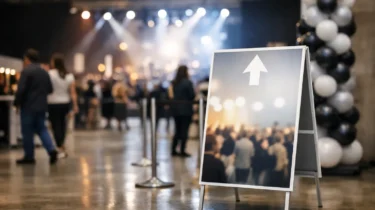
A delegate should be able to find registration, the seminar theatre or your stand without stopping to ask. Correx event signage boards are a practical way to put clear branded information exactly where it is needed, from venue entrances and car parks to shell-scheme walls and product demonstration areas.
Made from corrugated polypropylene, Correx is lightweight, water-resistant and economical for short-term display. It is particularly useful when an event needs multiple signs, fast turnaround and straightforward handling on site. The key is to treat each board as part of the visitor journey, rather than as an isolated printed item.
When Correx event signage boards are the right choice
Correx suits temporary exhibitions, conferences, roadshows, open days, product launches and retail activations where signs need to be moved, fixed or replaced without adding significant weight or cost. A 4 mm board is commonly specified for indoor directional signage, while thicker options can offer more stiffness where boards are freestanding or likely to receive heavier handling.
Its fluted construction keeps the material light enough for event teams to carry around a venue, yet gives it enough structure for temporary messages and branded graphics. Boards can be printed in full colour, cut to a required size and supplied with practical fixing options. This makes Correx useful for stand numbers, reception signs, timetable boards, sponsor recognition, wayfinding, safety messaging and promotional panels.
There is, however, a trade-off. Correx is not intended to replicate the premium, perfectly flat finish of acrylic or DiBond. For a long-term installation, a high-end retail environment or a sign that will be viewed at close range for months, another substrate may be more appropriate. For a busy event environment, where clarity, speed and cost control matter most, it is often the sensible choice.
Start with the event journey, not the artwork
Good signage planning begins before design files are produced. Consider how visitors arrive, where they queue, which routes they take and where they are most likely to hesitate. A board that looks excellent on screen but is positioned behind a registration desk, obscured by an open door or placed too high to read will not do its job.
For a typical exhibition, this may mean a welcome sign at the entrance, directional boards at decision points, clear labels for meeting areas and product zones, then concise calls to action on the stand itself. For a roadshow, the priorities may shift towards car park direction, building access, session times and room identification. The format changes, but the principle remains the same: provide information just before the visitor needs it.
Keep each message focused. A directional board should lead with the destination and use a large arrow. A registration sign should explain where to go and what to have ready. A product panel can carry more detail because visitors have chosen to stop and read it. Trying to combine all three functions on one board usually creates clutter.
Design for reading distance
Text size, contrast and placement have a direct effect on whether a sign works. Main headings need to be readable from the distance at which a visitor first sees them, while smaller supporting copy should only be used where people can stand close enough to read it. High contrast between type and background is generally more useful than subtle brand colours that lose definition under venue lighting.
Use familiar wording wherever possible. ‘Registration’, ‘Conference Rooms’, ‘Exit’ and ‘Coffee’ can be understood at a glance. If a venue has several spaces with similar names, pair the name with a simple directional cue. Consistent colours, fonts and icon styles across all boards help visitors understand that the signs belong to the same system.
Artwork should also allow for the board edges and fixing points. Keep important text, QR codes and logos away from drilled holes, corners and the outer trim area. Where Correx is cut to shape, allow enough material around narrow sections so that the board remains stable during transport and installation.
Choosing size, thickness and finish
There is no single board specification that suits every venue. Small A3 or A2 Correx signs can work well on doors, counters and registration desks. Larger panels are effective for wall-mounted wayfinding, entrance graphics and temporary backdrops. Oversized boards may need additional support, particularly in public areas with airflow, passing footfall or uneven surfaces.
For many indoor applications, 4 mm Correx offers a balanced combination of affordability and rigidity. A thicker board may be worth considering for larger formats, outdoor use or signs that will be handled repeatedly. If double-sided visibility is needed, such as a suspended sign or a board used in the middle of a room, this should be agreed at the planning stage so the print and fixing method can be matched to the application.
The direction of the internal flutes matters too. Where signs are fixed to stakes or need structural support, flute orientation can affect how they perform. It is a small production detail, but one that avoids problems once the boards reach site.
A matt finish can reduce glare under bright exhibition hall lighting, while vibrant printed graphics help brand colours remain visible across a large space. The most suitable finish depends on the artwork, the viewing distance and the venue lighting plan. A proof or sample can be useful when a campaign relies on precise colours or fine detail.
Fixing Correx boards safely in live venues
A lightweight board still needs secure installation. Venue rules, wall finishes and fire-safety requirements all influence the fixing approach. Depending on the location, boards may be installed with removable adhesive pads, hook-and-loop fasteners, cable ties, clips, drilled holes or purpose-made sign supports. The chosen method should hold the sign securely without damaging venue surfaces or creating a hazard.
Do not assume that a free-standing board can simply lean against a wall or display unit. In a crowded exhibition hall, it can be knocked over easily and may obstruct access routes. Signs near fire exits, escape routes, electrical distribution or emergency equipment need particular care. Venue organisers may also have restrictions on hanging items, applying adhesives or fixing graphics to shell-scheme panels.
For a complete stand build, signage should be planned alongside flooring, electrics, furniture, internet provision and display hardware. This prevents late changes such as trying to cover a socket, route a cable around a board or find space for a sign after the stand layout has already been approved. Risk assessments and method statements should reflect the installation work where required, especially for larger structures or out-of-hours builds.
Getting boards to site in usable condition
Correx is durable for its weight, but its edges and corners can be damaged if boards are loosely packed in a vehicle with heavier equipment. Large sheets can also bend if not stored flat and protected. Packing boards in labelled bundles, with corner protection where appropriate, makes installation faster and reduces the risk of opening the first box on site to find creased graphics.
Labelling is more valuable than it sounds. Include the event name, board location and quantity on each pack: ‘Main Entrance’, ‘Registration Desk’, ‘Theatre A’ or ‘Stand B42’. A site team can then distribute boards without cross-checking every artwork file. For multi-venue roadshows, this approach also helps ensure that the correct local dates, room names and directions travel with each event kit.
Timing matters as much as print quality. Event signage is frequently one of the last items to be finalised because programmes, sponsors and floorplans can change. Build enough time into the schedule for artwork approval, production, packing and delivery, while keeping a controlled route for genuine last-minute amendments. A dependable supplier can advise where Correx is suitable, produce the boards to agreed specifications and coordinate delivery or installation with the wider display package.
Trade Show Solutions can incorporate temporary signage into a complete exhibition or event environment, coordinating boards with modular stands, tension-fabric graphics, counters and on-site build requirements. That single point of coordination is particularly useful when several suppliers, venue rules and tight access times would otherwise need managing separately.
Make temporary signs work harder
The most effective Correx boards do more than fill empty wall space. They reduce uncertainty for visitors, keep queues moving, support staff conversations and protect the consistency of your brand across the venue. Before approving the final artwork, walk through the event from the perspective of someone arriving for the first time. If every next step is obvious, the signage is doing valuable work.