
Exhibition Venue Electrics Booking Made Simple
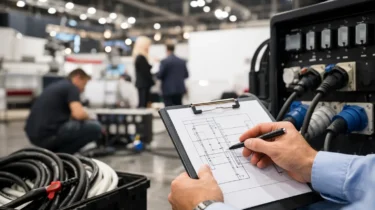
A stand can look excellent on a layout drawing and still fail to function once the doors open. Screens remain blank, illuminated graphics are dark, laptops compete for one socket and a coffee machine trips the supply just as visitors arrive. Exhibition venue electrics booking is therefore not an administrative extra. It is a core part of planning a usable, credible stand.
For most exhibitors, the challenge is not simply ordering power. It is working out what needs powering, where it will sit, how cables will be routed safely and which services must be booked through the venue or its appointed contractor. Getting those decisions right early protects the visitor experience, helps the build run to plan and avoids costly late orders.
Start with the stand plan, not the order form
The venue’s electrical order form will ask for quantities and supply types, but it cannot tell you what your stand actually needs. Begin with a stand plan that shows every item requiring power: display screens, LED lighting, illuminated counters, product demonstrations, charging points, refrigerated units, laptops, tablets and any hospitality equipment.
Location matters as much as total demand. A single socket at the rear of the stand may be technically sufficient for a small display, yet unsuitable if a screen sits on the front edge or a demonstration area is in the centre. Long extension leads across an open stand are not a practical answer. They create a poor finish, introduce trip risks and may not meet venue requirements.
A properly planned modular stand makes this easier. Cable routes can be designed into the layout, with power delivered behind graphics, within counters or through the structure where appropriate. The result is a cleaner branded environment, without visible leads distracting from products or conversations.
What to check before exhibition venue electrics booking
Before placing an order, review the exhibitor manual and technical regulations for the specific event. Requirements differ between venues and organisers. Some venues require all electrical supplies to be ordered through their approved provider, while others permit an appointed contractor to carry out certain work under agreed conditions.
Check the order deadline first. Advance-rate dates are often several weeks before the event, and prices can rise sharply after that point. Late orders may also limit the locations available for floor boxes or supplies, particularly on busy shows where services are planned around the final floor layout.
You should also confirm whether the stated electrical supply is live for the full duration you need it. If a fridge, equipment display or charging system must remain on overnight, this needs to be specified. Many standard supplies are switched off outside show hours unless a 24-hour supply has been ordered.
The following details should be confirmed before the booking is submitted:
- the stand number, hall and exact stand dimensions
- a scaled plan showing the required socket or floor-box positions
- each electrical item, its wattage and whether it requires continuous power
- the type of supply needed, including any higher-load or three-phase requirement
- cable-routing requirements and any lighting built into the stand
- the venue’s deadlines, rules and health-and-safety documentation requirements
This information gives the venue contractor a usable instruction rather than a broad request for “a couple of sockets”. It also gives your stand builder and installation team time to identify any layout changes before materials are produced.
Calculate the load realistically
The most common planning error is underestimating power demand. A phone charger or laptop has a modest draw, but multiple screens, LED walls, lighting transformers, product equipment and hospitality appliances can add up quickly.
Check the manufacturer’s stated wattage for each item rather than relying on assumptions. Add the wattage together, then allow a sensible margin for equipment that may be added later. The supply needs to accommodate the expected load without being pushed to its limit. Where equipment has a high start-up load, such as some refrigeration or mechanical products, discuss it with the venue electrician in advance.
Do not confuse the number of sockets with the available capacity. Four sockets on one small supply do not provide four times the power. They share the same overall allowance. A multiway extension may increase connection points, but it does not increase the supply capacity.
For a straightforward portable display with a screen and a few lights, a standard supply may be enough. A larger modular stand with illuminated fabric graphics, several displays and a working demonstration area may need multiple circuits or a more substantial supply. The right answer depends on the equipment, the design and the venue specification.
Plan cable management into the build
Visitors notice untidy cables even when they cannot say why the stand feels unfinished. More importantly, exposed leads across walkways or behind open counters can create a trip hazard and cause problems during venue inspection.
Power should be planned alongside flooring and stand construction. Raised exhibition flooring can provide protected routes for cables, while counters, storage cupboards and modular framework can conceal connections without restricting access. If the stand is open on several sides, the position of floor boxes becomes especially important because there may be nowhere to hide a lead from a perimeter wall.
This is one reason the lowest-cost electrical order is not always the best decision. Ordering a supply at the wrong location may require last-minute cable ramps, altered furniture positions or a compromised screen location. A well-positioned supply can save time during installation and preserve the intended visual impact.
Where a stand includes custom joinery, a T3 modular structure or tension-fabric graphics, electrical details should be shared before production and not left until build day. Trade Show Solutions can coordinate the stand plan, venue services and installation requirements as one delivery process, so the physical build and technical services work together.
Understand what the venue will and will not provide
Booking a supply does not necessarily mean every cable, adapter and appliance connection is included. Venue electrical contractors commonly provide the incoming supply and may install sockets in the ordered position, but the scope varies. Your exhibitor manual should state what is supplied and what must be provided by the exhibitor or stand contractor.
Bring only appropriate, tested equipment. Portable electrical equipment used at an exhibition should be safe, in good condition and suitable for the intended load. Venues may ask for evidence of portable appliance testing, particularly for older equipment, high-load appliances or equipment brought in from outside the UK.
Avoid packing domestic extension reels and hoping they will solve gaps on site. They can be unsuitable for the environment, overloaded or rejected by the venue team. If additional distribution is required within the stand, specify it during planning so it can be supplied and installed correctly.
Coordinate electrics with internet, lighting and demonstrations
Electrics rarely sit alone. A lead-capture system may need both a socket and a dependable internet connection. A product demonstration may need power, water, extraction or a specific safe working area. Digital displays need power in positions that support sightlines, while lighting needs to complement graphics without creating glare on screens.
Consider the visitor journey. If a large screen is intended to draw attention from the aisle, its power point should support that exact placement. If staff will demonstrate a product from a counter, include power within or directly behind the counter rather than relying on a loose lead. If visitors will charge devices, decide whether this is a managed hospitality feature or simply an open socket that needs supervision.
The practical question is not “what can we plug in?” It is “what does this stand need to do throughout the event?” That approach produces better service orders and a more dependable stand operation.
Build-day checks prevent small problems becoming delays
Once the stand is installed, test every electrical item before the event opens. Turn on screens, lighting, charging points, product equipment and any illuminated graphics. Check that cables are protected, sockets are accessible where needed and no power load trips when equipment runs together.
If anything is missing or positioned incorrectly, raise it with the venue contractor immediately. Build day is the time to resolve an issue. Waiting until the first morning of the show leaves fewer options and puts pressure on staff who should be preparing to meet visitors.
Keep a copy of the final electrical plan with the event file, along with order confirmations, equipment details and any relevant risk assessments or method statements. This is particularly useful for repeat events, where a proven layout can be reused and refined rather than planned from scratch each time.
A successful stand is more than graphics and hardware. When electrics are planned as part of the build, your team arrives to a working space that supports conversations, demonstrations and lead generation from the first visitor onwards.