
Event Branding That Works on the Exhibition Floor
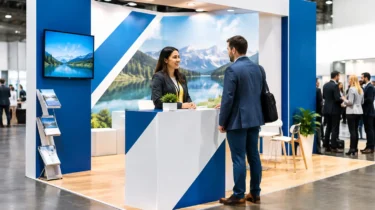
A busy exhibition hall gives visitors only a few seconds to understand who you are, what you offer and whether your stand is worth approaching. Event branding is what makes that judgement easy. It turns a rented shell scheme, conference foyer or roadshow space into a recognisable business environment with a clear purpose.
The strongest event spaces do more than carry a logo. They guide people towards a conversation, support the sales team and give product messages room to work. Just as importantly, they are planned around the practical conditions of the venue: access times, stand height limits, electrics, flooring, internet connections, safety requirements and build schedules.
Start event branding with the visitor journey
Before choosing a display system or approving artwork, decide what a visitor needs to see first. At a trade show, that may be a short statement of the problem you solve. At a product launch, it might be the product itself. At a conference, the priority may be making your team easy to find among a crowded sponsor area.
This first message should work from a distance. Your business name and core proposition need enough scale and contrast to be read across an aisle, rather than relying on a paragraph of copy that only becomes visible once someone is already standing at the stand. Supporting messages, technical specifications and calls to action can then sit closer to the conversation area.
Think in zones. The outer edge of the space attracts attention, the centre provides the proof and the meeting area gives staff somewhere to turn interest into a useful discussion. This approach helps avoid a common problem: filling every available panel with information and leaving visitors unsure where to look.
A visual hierarchy also makes graphics more reusable. A modular backdrop can carry the main brand message, while replaceable panels promote a particular product, campaign or sector focus. That is usually more cost-effective than rebuilding an entire stand every time the marketing message changes.
Match the display format to the event
There is no single correct format for event branding. The right choice depends on the floor space, how often you exhibit, whether the stand travels between venues and how much flexibility you need from one event to the next.
Tension-fabric displays are a practical option for conference backdrops, smaller exhibition spaces and portable activations. Their lightweight frames and fitted printed graphics create a clean, high-impact finish without the weight and complexity of traditional build methods. They are particularly useful where a small team needs a display that can be transported and assembled efficiently.
For businesses with a regular event programme, a modular system can offer greater long-term value. T3 modular exhibition stands use reusable, tool-free components that can be configured for different footprints and objectives. The same hardware may form an open corner stand at one show, a meeting-focused layout at another and a product demonstration area at a third. New graphics can refresh the look without replacing the underlying structure.
Shell-scheme exhibitors need the same level of thought, even when the venue provides the basic walls. Well-fitted printed panels, clear fascia branding, a counter and coordinated signage can make a standard shell scheme feel considered rather than temporary. It is often the detail that separates a credible presence from a stand that disappears into the row.
Build consistency beyond the main stand
A branded backdrop alone cannot carry the whole customer experience. Event branding works best when the display, printed materials and operational touchpoints look as though they belong together.
Counters are a good example. They are where visitors stop, collect literature, scan a QR code or start a conversation, so they should reinforce the main message rather than become an afterthought. The same applies to product plinths, literature holders, banner stands, wayfinding signs and demonstration areas.
Large-format print gives exhibitors the freedom to apply the brand where it has a practical job to do. Foamex boards work well for durable event signage and display panels. Acrylic can create a more premium finish for reception areas or product messaging. DiBond is suited to rigid, hard-wearing applications, while Correx can be a sensible choice for temporary directional signage where budget and short-term use matter.
Material selection is not simply an aesthetic decision. Consider whether signs will be reused, whether they need to withstand transport, how they will be fixed and whether venue rules limit certain installation methods. A premium-looking finish that cannot be installed safely or cannot survive repeat use is rarely good value.
Plan for the venue, not just the artwork
The visual side of an event often receives the earliest attention, while the operational side is left until deadlines start to tighten. That creates avoidable pressure. A stand can have excellent graphics and still fail to perform if power is in the wrong place, the floor finish is unsuitable, internet has not been ordered or the build team cannot access the hall when needed.
Venue regulations vary considerably. Organisers may require plans, risk assessments, method statements, proof of insurance, electrical information or details of any suspended elements. They may also set rules around build height, fire-rated materials, floor loading, delivery slots and waste removal. These requirements are not administrative extras. They directly affect what can be built, how it is built and whether it can open on time.
A practical event plan should confirm the stand footprint, orientation, arrival route, storage requirements and service positions before production begins. If staff need power for screens, product demonstrations or laptop charging, that should inform the layout. If lead capture depends on reliable connectivity, plan the internet provision early rather than relying on mobile signal in a busy hall.
Flooring deserves similar attention. It can define the stand boundary, improve comfort for staff working long hours and conceal cables where appropriate. But raised platforms, ramps and cable routes must be planned with safety and access in mind. The most polished display is one that visitors and staff can use comfortably throughout the day.
Design for real conversations
A stand is not a brochure enlarged to room size. It is a working sales environment. The layout must give your team sightlines across the aisle, space to welcome visitors and enough room for meaningful conversations without blocking access.
Product-led businesses may need demonstration points with screens, power and secure storage. Service businesses often benefit from a clearer meeting area, concise case-study messaging and a backdrop that makes the offer instantly recognisable in photographs. Organisations attending recruitment events may need open space and an approachable atmosphere rather than a heavily enclosed stand.
It depends on the objective. If the event is primarily about lead generation, make the action you want visitors to take obvious. If it is about brand awareness, invest more in scale, consistency and standout positioning. If you are launching a complex product, allow for demonstrations and trained staff rather than trying to explain everything through graphics.
Avoid placing important messages too low, where furniture and people will obscure them, or too high, where they are difficult to read. Keep the strongest visual elements facing the main traffic flow. During planning, consider what the stand will look like when it is busy, not only when it is empty and photographed before doors open.
Make reuse part of the commercial decision
Event branding can be a one-off production exercise, but it is often more commercially sensible to plan for reuse from the start. Reusable hardware, interchangeable graphics and durable signage can reduce the cost and lead time of future events while maintaining a consistent brand presence.
This does not mean every element needs to be permanent. Campaign messages, event-specific offers and dated content should be easy to replace. The core investment should sit in flexible structures, quality base graphics and components that can adapt to different spaces. Portable display systems may be ideal for a sales team attending regional events, while a modular stand offers better flexibility for a business exhibiting repeatedly at larger shows.
Storage, transport and installation should be part of the calculation. A display that is inexpensive to buy but difficult to move, rebuild or maintain may become costly over time. Conversely, a higher initial investment can make sense where it saves repeated stand-hire costs and gives greater control over the finished environment.
Give one team ownership of delivery
Fragmented supply chains create risk. When one supplier prints graphics, another hires the stand, a third manages electrics and an internal team is left to coordinate paperwork and installation, responsibility can become unclear when something changes.
A coordinated approach brings the display system, graphics, signage, logistics and on-site build into one managed plan. It makes it easier to check that artwork fits the structure, services align with the layout and documentation is submitted at the right time. It also gives the client one accountable point of contact when schedules move or venue requirements change.
Trade Show Solutions combines these elements, from modular and tension-fabric displays to large-format print, venue coordination and installation. For busy marketing and event teams, that practical ownership removes a significant amount of event-day complexity.
The best event space is not the one with the most graphics or the largest footprint. It is the one that makes your brand immediately clear, gives your people the right setting to work and arrives ready to perform when the doors open.