
Tool Free Frames Versus Truss for Exhibitions
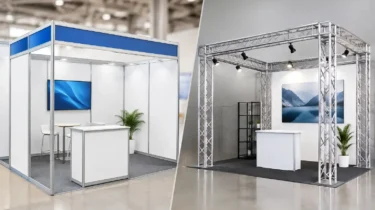
A stand can look impressive on a visual, then become difficult the moment it reaches a busy exhibition hall. The decision between tool free frames versus truss affects far more than appearance: it shapes transport, build time, graphic options, venue approvals, storage and how easily the stand can be reused at the next event.
Both systems can create a professional branded presence. The right choice depends on what the stand needs to do, who will build it and how often it will change. For many exhibitors, the most cost-effective route is not the system with the lowest initial price, but the one that removes the most friction across a full event programme.
Tool Free Frames Versus Truss: The Core Difference
Tool-free frame systems use modular components that connect by hand, allowing structures to be assembled without traditional tools. T3-style modular systems, for example, use reusable frames, connectors and graphic panels to create exhibition walls, meeting spaces, product displays, counters and storage areas. Their strength is adaptability: the same core stock can often be reconfigured for different stand footprints.
Exhibition truss is an aluminium lattice structure, typically connected using pins, bolts or purpose-made couplers. It has a distinctive engineered look and is widely used where overhead features, lighting positions, rigging points or large structural spans are required. Truss can be freestanding, but it is often selected as part of a larger technical build involving lighting, audiovisual equipment and venue rigging services.
Neither is automatically better. Tool-free frames are usually the practical choice for clean, graphic-led exhibition environments that need to be reconfigured and reused. Truss comes into its own when the design depends on height, suspended equipment or a deliberately industrial visual style.
Build Speed and Event-Day Control
A tool-free frame system reduces the number of separate activities required on site. Components arrive labelled, the frame is assembled in a planned sequence, and printed graphics or panels are fitted to complete the space. This can make installation more predictable, particularly for shell-scheme upgrades, smaller space-only stands, roadshows and events with restricted build access.
The benefit is not simply that no spanners are needed. A well-planned modular system can reduce the amount of loose hardware, the chance of missing fixings and the time spent resolving small assembly problems under pressure. It is also easier to create a repeatable build plan when the stand will travel to several venues.
Truss installation is often more involved. Sections must be positioned accurately, joined securely and, where applicable, checked as part of the event’s structural or rigging process. A ground-supported truss structure may still be a suitable option, but it needs sufficient floor space during construction and competent installers. If the design includes flown truss, the venue will usually require approved rigging contractors, booked rigging points and advance technical information.
For a straightforward branded environment, that extra process may add cost without improving the visitor experience. For a lighting-heavy launch or a stand that needs an elevated banner, screen or lighting grid, it can be essential.
Who is building the stand?
This question should be answered early. A marketing team may be comfortable assembling a compact tool-free display after a briefing, while a larger modular build may still benefit from professional installation. The system is simple to assemble, but that does not remove the need for accurate planning, safe working practices and a polished finish.
Truss should generally be treated as an installation-led solution. Even when the structure appears simple, its weight, height and connection method require a disciplined build process. At larger venues, build teams may also need to work around scheduled deliveries, loading bay rules and restricted access times.
Visual Impact and Brand Finish
Tool-free frames suit brands that want the architecture to sit behind the message. Full-height printed fabric, rigid graphic panels, illuminated elements and integrated shelving can produce a clean, contemporary stand with broad, uninterrupted branded surfaces. This works particularly well where the stand needs to feel like a finished sales environment rather than a temporary technical structure.
Because graphics can be replaced independently of the main frame, the same system can support new campaigns, product launches or different audiences. A company might retain the hardware for several years while refreshing a fabric wall, product message or counter graphic for each event.
Truss is more visible by nature. Some brands actively want that look, especially in technology, automotive, live events and industrial sectors. It can make scale and height immediately apparent, and it gives lighting designers useful fixing positions. The trade-off is that the structure becomes part of the visual language. If the brief calls for a refined, minimal finish, truss may need additional cladding, graphics or lighting treatment to avoid looking too functional.
There is also a practical branding consideration. A truss stand often relies on separate graphic walls, banners or printed panels fitted within or around the structure. Those elements need to be planned alongside cable routes, access points and lighting positions. A modular frame system is normally designed around its graphics from the outset, which can make the final result more integrated.
Transport, Storage and Reuse
For exhibitors attending multiple events, logistics often decide the argument. Tool-free frames are designed as reusable components. They pack into cases or flightcases, can be stored between shows and can be reconfigured to suit different footprints. A 3m x 3m stand does not need to remain a 3m x 3m stand forever: with the right component plan, parts can be used for a larger corner stand, a backwall, a meeting area or a branded reception point.
That flexibility is valuable when event calendars change. It also reduces the need to buy a completely new stand whenever a venue allocates a different space. Replacement graphics can be produced for a particular campaign while the core investment remains in service.
Truss is durable and reusable too, but it is generally heavier, bulkier and less forgiving in transport. Individual sections, bases, braces, couplers and accessories need careful packing and checking. Depending on the design, it may require more vehicle space and more labour for loading and unloading. This is manageable for established programmes, but it is rarely the most convenient choice for teams that need to move displays regularly or store them in limited premises.
Venue Rules, Safety and Technical Planning
Every exhibition venue has its own technical rules, and these can change the feasibility of a design. Height limits, boundary regulations, emergency exits, fire ratings, floor loading, rigging policies and build-up times all need to be considered before production begins.
Tool-free frames are often easier to accommodate because they can be designed as self-supporting, ground-level structures. However, they still need a suitable structural plan, particularly where tall walls, enclosed rooms, overhead signs or integrated screens are involved. Graphics and materials must meet the organiser’s fire-safety requirements, and the stand may require risk assessments and method statements before installation.
Truss can introduce further checks. A flown element requires rigging approval, calculations and coordination with the venue’s appointed contractor. Even ground-supported truss may need details of its footprint, ballast, overall height and intended loads. Add lighting, screens or speakers, and the electrical plan becomes more significant. None of this rules truss out, but it makes early planning essential.
A managed exhibition supplier can coordinate these details alongside flooring, electrics, internet and on-site installation. This is particularly useful when internal teams need one accountable partner rather than separate print, hardware, logistics and build suppliers.
When Tool-Free Frames Are the Better Fit
Choose a tool-free modular frame approach when the priority is a premium branded finish, adaptable layouts and efficient reuse. It is well suited to exhibitors who attend several events each year, need different stand sizes, want to refresh graphics without replacing the structure, or need a practical route to creating product zones, meeting areas and storage.
It is also a strong option when a stand must work hard with limited internal resource. The hardware can be planned around realistic transport, storage and installation arrangements rather than an idealised concept that becomes expensive to deliver.
When Truss Is Worth the Extra Complexity
Truss is the better fit where the structure must support a technical brief that frames alone cannot achieve. That may include high-level lighting, audiovisual equipment, large spans, substantial hanging elements or a deliberately engineered event aesthetic. It can create impact at scale, especially in large halls where height and illumination are central to attracting attention.
The key is to budget for the full delivery requirement, not just the truss sections. Factor in transport, installation labour, venue services, electrical distribution, rigging where required, safety documentation and the time needed to build and dismantle correctly.
Trade Show Solutions can help turn either route into a workable exhibition environment by matching the display system to the space, programme and practical demands of the venue. The most useful starting point is a clear brief: stand size, event frequency, brand objectives, products on display, technical requirements and who needs to use the space. With those details agreed before production, the finished stand is far more likely to arrive ready to work when the doors open.